Pourquoi un père et son fils du Béarn ont créé Vignopedia
Why a father and son from Béarn created Vignopedia
Tout est parti d’une conversation
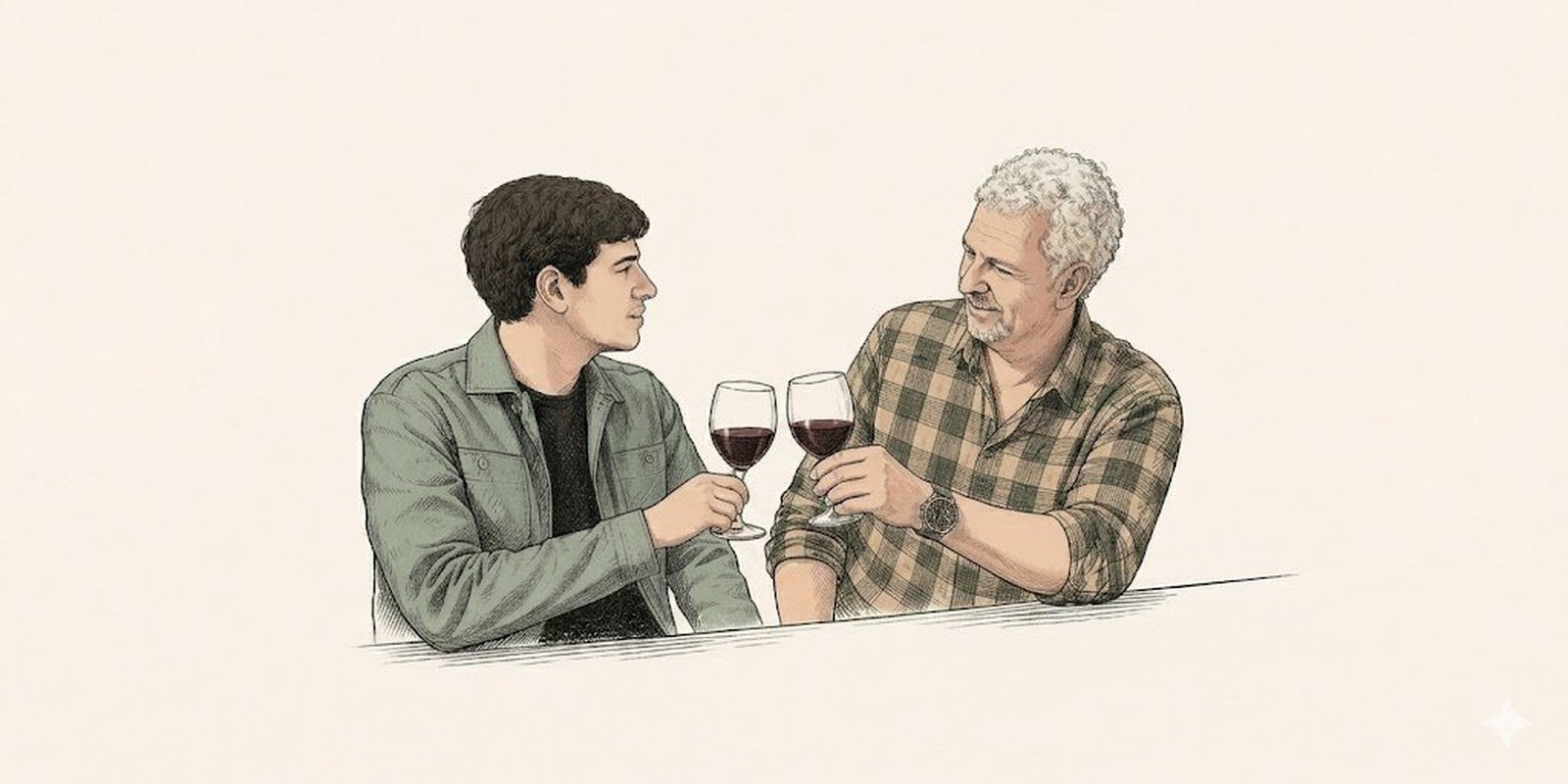
C’était un soir, autour d’un Madiran. Mon père avait ouvert la bouteille en avance, « celui-là, il a besoin de respirer ». Je lui ai demandé pourquoi.
Et il m’a répondu. Pas en deux mots. En vingt minutes. Il m’a parlé du Tannat, ce cépage tellement tannique que les vignerons des années 80 voulaient l’arracher. Il m’a raconté comment un homme, Patrick Ducournau, a popularisé à la fin des années 1990 une technique qu’on appelle la micro-oxygénation, et comment cette technique a transformé l’avenir d’une appellation entière. Comment ce même raisin a traversé l’Atlantique avec des Basques émigrés, et qu’il est devenu là-bas le cépage emblématique de l’Uruguay.
En vingt minutes, sans jamais utiliser un mot que je ne comprenais pas, mon père avait traversé la génétique, l’histoire régionale, l’innovation technique et la géopolitique. C’est là que j’ai compris ce qui manquait.
Un espace vacant
J’avais cherché des ressources pour apprendre le vin. J’avais trouvé, d’un côté, des manuels écrits pour des professionnels, des contenus légitimes mais qui présupposent un bagage que la plupart des gens n’ont pas. De l’autre, des formats courts, calibrés pour les algorithmes, qui donnent l’illusion de comprendre sans jamais rien transmettre de profond. Le premier espace intimide. Le second ne respecte pas l’intelligence de celui qui cherche.
Ce que mon père faisait ce soir-là, sans le théoriser, c’était autre chose. Il racontait le vin comme un objet où convergent les sciences de la nature et les sciences humaines, avec des mots simples et un respect absolu pour la complexité du sujet. Il faisait de la vulgarisation scientifique interdisciplinaire au-dessus d’un verre de Tannat. Et nulle part sur internet, je n’avais trouvé l’équivalent de cette parole.
Ce qu’on construit
Vignopedia est née dans cet espace vacant. Une application d’éducation au vin qui ne prétend pas que le sujet est simple, mais qui affirme qu’il est accessible à quiconque accepte de s’y intéresser. Chaque leçon croise les disciplines : un article sur le sol vous emmène vers l’histoire médiévale, un article sur les cépages vous conduit aux routes de l’émigration basque (comme le Malbec qui a traversé l’Atlantique au XIXe siècle). Le vin y est traité non pas comme un produit de consommation, mais comme un objet de connaissance.
Soyons clairs : nous ne sommes pas œnologues, ni sommeliers. Mon père connaît le vin par le terrain, trente ans de routes viticoles dans le piémont pyrénéen, les noms des vignerons, la mémoire des millésimes. Moi, j’apporte le code et la curiosité d’un fils qui a grandi avec ces histoires sans jamais les trouver ailleurs que dans la bouche de son père. Ce que nous faisons, nous le faisons en nous appuyant sur des travaux de chercheurs, des publications scientifiques, et les retours de ceux qui en savent plus que nous. Nous ne prétendons pas avoir tout compris, nous prétendons que le chemin pour comprendre mérite d’être partagé.
Le parcours Découverte est gratuit. Et il commence exactement là où cette conversation a commencé.
→ Inscrivez-vous à la newsletter pour être prévenu de l’ouverture de l’application le 15 juin
↳ Vous voulez voir ce qu’on y raconte ? Nos articles sont par là.
It all started with a conversation
It was an evening, over a Madiran. My father had opened the bottle ahead of time, “this one needs to breathe.” I asked him why.
And he answered. Not in two words. In twenty minutes. He told me about Tannat, a grape so tannic that winemakers in the 1980s wanted to rip it out. He told me how a man named Patrick Ducournau popularised a technique called micro-oxygenation in the late 1990s, and how that technique transformed the future of an entire appellation. How that same grape crossed the Atlantic with Basque emigrants, and became the flagship variety of Uruguay.
In twenty minutes, without ever using a word I didn’t understand, my father had crossed genetics, regional history, technical innovation and geopolitics. That’s when I understood what was missing.
A vacant space
I’d looked for resources to learn about wine. On one side, I found manuals written for professionals, legitimate content, but presupposing knowledge most people don’t have. On the other, short formats calibrated for algorithms, giving the illusion of understanding without ever transmitting anything deep. The first space intimidates. The second doesn’t respect the learner’s intelligence.
What my father was doing that evening, without theorising it, was something else. He was telling wine as an object where natural sciences and humanities converge, with simple words and absolute respect for the subject’s complexity. He was doing interdisciplinary science communication over a glass of Tannat. And nowhere online had I found the equivalent of that voice.
What we’re building
Vignopedia was born in that vacant space. A wine education app that doesn’t pretend the subject is simple, but affirms it’s accessible to anyone willing to take an interest. Each lesson crosses disciplines: an article on soil takes you to medieval history, an article on grape varieties leads you to Basque emigration routes (like the Malbec that crossed the Atlantic in the 19th century). Wine is treated not as a consumer product, but as an object of knowledge.
Let’s be clear: we’re neither oenologists nor sommeliers. My father knows wine through the land, thirty years of wine roads in the Pyrenean foothills, the names of the winemakers, the memory of vintages. I bring code and the curiosity of a son who grew up with these stories without ever finding them anywhere but in his father’s words. What we do, we do by relying on researchers’ work, scientific publications, and feedback from those who know more than us. We don’t claim to have understood everything, we claim the journey toward understanding is worth sharing.
The Discovery track is free. And it starts exactly where that conversation started.
→ Sign up for the newsletter to be notified when the app opens on June 15
↳ Want to see what we write about? Our articles are over here.
Le parcours Découverte est gratuit et dure 30 minutes.
Découvrir l’application